Racial tension
I'd Like to Apologize to Every Teacher I Ever HadRacial tension in Tony Danza’s account of Northeast High School is revealed in charged, specific encounters: a student’s fights, a parent’s confrontation in a crowded corridor, and classroom debate over discipline and fairness. The episodes show how violence acquires racial meaning, how people disagree about its causes, and how Danza tries to keep students’ actions from becoming fixed judgments about entire groups. They do not amount to a comprehensive account of race relations at the school; their force lies in the competing interpretations the narrative makes visible.
School Context and Scope
Northeast High School is a large Philadelphia public school with a sprawling campus, multiple sports fields, a football stadium, and a police station. Its scale provides the setting for encounters among students, families, and staff in corridors and classrooms, but the memoir’s evidence about racial tension centers on particular incidents rather than school-wide statistics or policy analysis. The distinction matters: the scenes reveal the stakes of how individuals understand conflict without establishing that every student or teacher shares the same experience.
The account also describes its own basis and limits. Danza says he drew on diary entries, lesson plans, emails, videotape, online postings, and memory, while cautioning that the television series filmed in his classroom could alter events. The book therefore presents racial tension through a teacher’s situated recollections and interpretations, not as a detached survey. Its scenes preserve disagreement—including disagreement about what a conflict means—rather than resolving every question about its causes.
Matt’s Fights and Racialized Conflict
Matt’s case brings racial conflict into the classroom and onto the school grounds. He is a high-energy student and a football linebacker, but his tendency to provoke or answer physical confrontations has already made him a disciplinary concern. By the end of October, he is tied for the school record for the most fights. After a friend is jumped, Matt gets into a fight with African-American students; later, four of those same students jump him and badly bruise his face.
The sequence complicates any simple division between aggressor and victim. Matt has a history of fighting, yet he has also been seriously attacked. His father tells Danza that Matt is restless and that he has reported problems with other students. A girl in class identifies a racial element in the conflict. After the attack, Matt’s manner changes: he seems perpetually close to exploding. The account links that volatility to the assault without suggesting that one explanation cancels out the others—his earlier conduct, the violence against him, and the racial interpretation voiced by a classmate all remain part of the situation.
Danza’s response is to enlist Matt’s father in addressing his attitude, rather than treating the fight as an isolated disciplinary episode. When Matt later faces possible expulsion, Danza also asks whether he would speak with a counselor. Matt agrees, and a meeting with his parents, a counselor, and a department head results in a plan for regular counseling. The intervention offers a route toward support, but the events that follow show how quickly adult efforts to help can be pulled into a wider conflict over the school itself.
The Hallway Confrontation and Its Aftermath
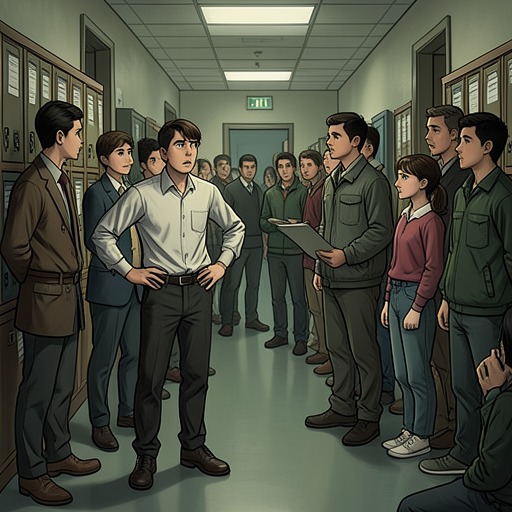
After the meeting, Matt’s parents encounter a group of Black girls in a crowded corridor as students change classes. The girls are using racial epithets and other crude language. Matt’s father first gives them an opportunity to stop, then asks them to watch their language because he is walking with his wife and they are at school. The girls take offense, insult the parents, and turn the exchange into a shouting match.
The confrontation changes the father’s view of his son’s complaints. He tells Danza that he now believes Matt’s descriptions of the school and its students. Danza objects to Matt hearing that confirmation: he fears it will reinforce the boy’s belief that the whole school is against him. He instead explains the girls’ behavior as a form of communication shaped by what they encounter at home and in the media, and stresses that they are children. That explanation is Danza’s interpretation, not a neutral resolution of the confrontation; the scene leaves in view both the parents’ experience of the girls’ language and the teacher’s effort to prevent a single encounter from hardening into a general verdict about Northeast.
The father agrees to let Matt finish the school year but says he will send him to a Catholic school the following year. Danza is reluctant to concede the point, yet recognizes that a more disciplined setting might help Matt. The episode thus ends without reconciliation between the family and the school. Its immediate consequence is a conditional decision to stay; its larger significance is the way a hallway encounter becomes evidence, for Matt’s father, in an argument about whether the school can meet his son’s needs.
Classroom Debate and Social Justice
Racial tension also touches discussions that are not themselves presented as direct racial confrontations. In a classroom debate over school uniforms, Paige objects that she should not be punished because of what other girls wear. Her comment shifts attention toward who is judged and disciplined for clothing. The passage does not identify the racial identities of the students in this exchange, so it cannot establish a specifically racial dispute; it does show students contesting how rules distribute blame and whose conduct becomes the problem.
Danza connects a broader curriculum theme of social justice to the students’ lives through poetry and Coolio’s Gangsta’s Paradise. The class has repeatedly considered equal opportunity and how people respond when denied a fair chance to succeed, beginning with Of Mice and Men. Danza says the theme resonates with students because they are made aware of disadvantage, and with him because he believes his own opportunities depended on luck. The lesson does not reduce racial tension to literary analysis; rather, it places questions of dignity, opportunity, and reaction to unfairness within a shared classroom inquiry.
Narrative Significance
Across these episodes, racial tension is neither a single event nor a settled explanation. It appears in Matt’s fights, the father’s reading of his son’s experience, the girls’ language, Danza’s attempt to distinguish individual behavior from judgments about a whole school, and students’ arguments over fairness. Each interpretation has consequences: Matt’s assault alters his demeanor, his father’s confrontation deepens his distrust, and the possibility of changing schools enters the family’s plans.
The memoir’s emphasis on particular scenes keeps those consequences concrete while exposing the limits of the narrator’s authority. Danza intervenes as a teacher and offers cultural explanations, but the episodes do not prove that his account exhausts the students’ perspectives or the school’s racial dynamics. Racial tension matters to the narrative precisely because it resists a simple lesson: a teacher may try to protect a student from a damaging generalization, yet that effort cannot erase the violence, language, and institutional mistrust that made the generalization persuasive to a parent.